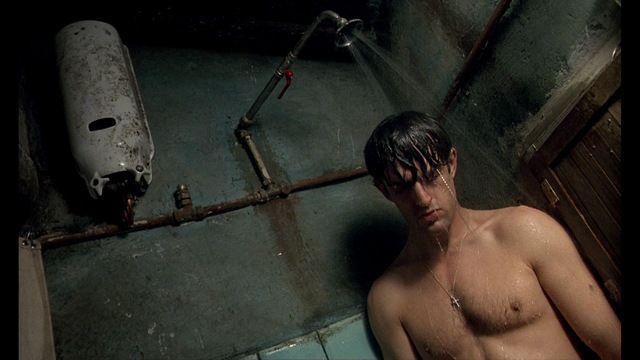
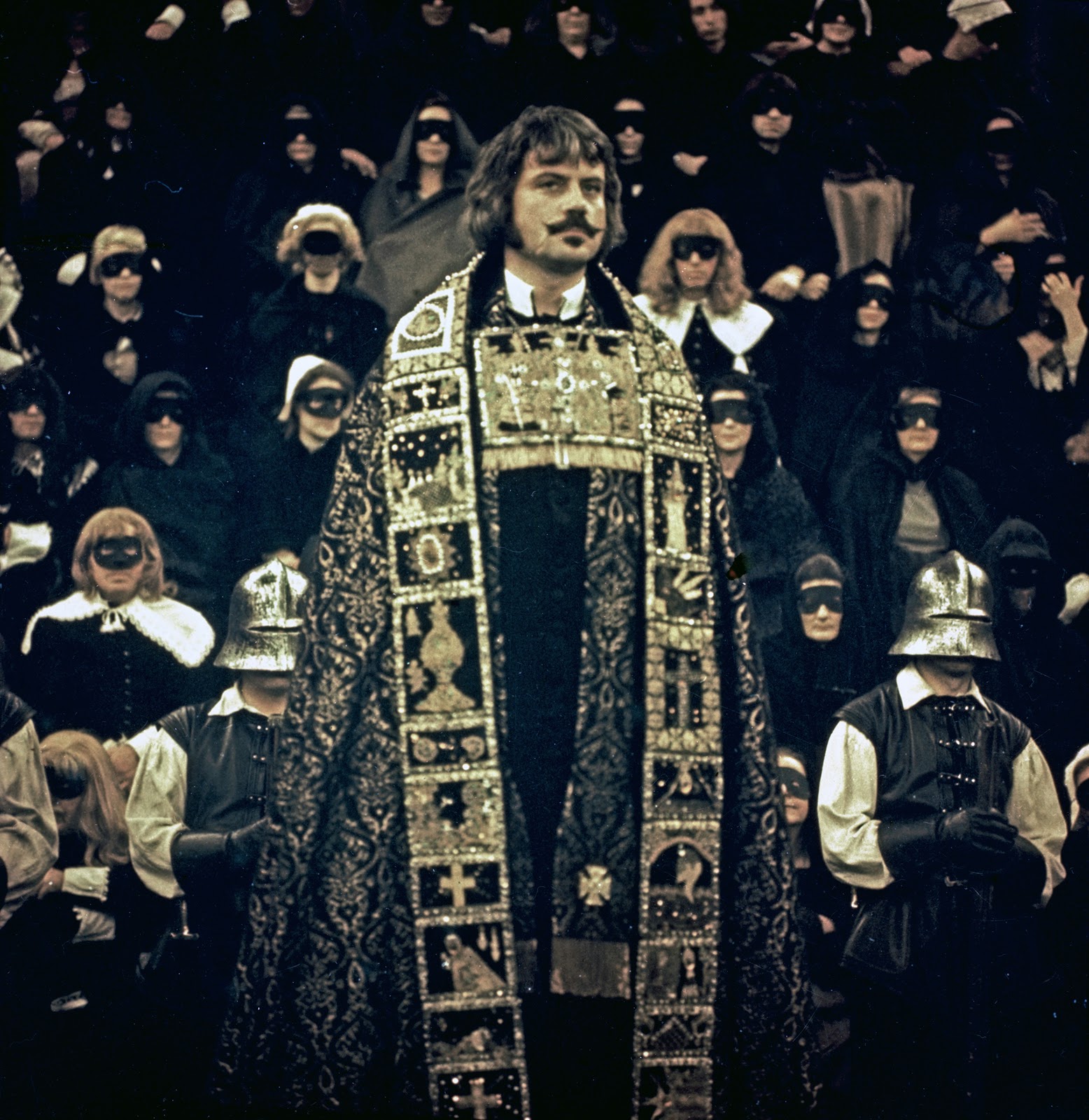
The great English director Alan Clarke (1935-90) was best known for his unflinching portraits of working-class life. Films like Scum (1979), Made in Britain (1982) and the Andrea Dunbar scripted Rita, Sue and Bob Too (1986) were firmly in the social realist tradition. So Clarke directing a musical about a snooker match between a cowboy and a vampire was something of a departure.
Billy ‘the Kid’ (Phil Daniels) is a 20-year old rising star on the snooker circuit whose unconventional ways rile the snooker establishment. His manager T.O. aka ‘The One’ (Bruce Payne) is in debt to a gangster (Don Henderson) who demands a showdown match between Billy and the reigning world champion Maxwell Randall (Alun Armstrong), ‘the Green Baize Vampire.’ Randall represents the old guard and demands a 17 frame match with the loser never playing snooker again.
Back in the 80’s snooker was hugely popular in the United Kingdom. Players like Steve Davis, Alex ‘Hurricane’ Higgins and Dennis Taylor were household names. The most striking player at the time was Ray Riordon, a tall, dark figure with a passing resemblance to ‘Dracula’ star Bela Lugosi. Clarke and his writer Trevor Preston based the Green Baize Vampire on Riordan and the brash youngster ‘the Kid’ on the young Jimmy White.
The showdown takes up the final half hour of the film. Clarke keeps things interesting by having Daniels and Armstrong performing their own shots so he can keep the actors in the frame and use sweeping camera angles. There is an expressionist feel to the sets. Everything takes place at night and we never see daylight. Though it seems Randall is just playing at being a vampire there are a couple of moments that suggest he may very well be a creature of the night.
Billy the Kid and the Green Baize Vampire sits uneasily alongside Clarke’s social realist work and is often avoided when critics discuss his work, but there is still a political element with Maxwell representing the establishment and Billy the underclass. Daniels is perfectly cast as the cocky youngster, while Armstrong is an amusing mixture of Northerner and the supernatural. Composer George Fenton ( The Company of Wolves ) acted as the musical arranger for the film. Bruce Payne has a terrific singing voice and gets the best number, ‘I’m The One.’
Billy the Kid and the Green Baize Vampire is unique. It is fair to say there will probably never be another film combining Westerns, vampires, and snooker. Sadly it came out shortly after another British musical, the ruinous Absolute Beginners (Julien Temple 1986) and despite the popularity of snooker Billy the Kid and the Green Baize Vampire never found the audience it deserved.
Uncategorized

Colin Clark seems to be the only person who benefited from the awful movie The Prince and the Showgirl (1957, Laurence Olivier) getting two factually dubious memoirs ‘The Prince, the Showgirl, and Me’ and ‘My Week with Marilyn’ out of the whole farrago. There might well be an interesting story behind this culture clash between two American icons and the British theatrical establishment but Colin Clark has bugger all to do with it. Norman Mailer thought it was comic, the British fancy folk with their curious rituals against two Americans who were self-made and despite their success both painfully shy and out of place.
For the Millers are tied in class knots. English accents, Olivier’s in particular, have to certainly remind them that she is a girl from a semi-slum street and he is a boy from Brooklyn.
Norman Mailer, Marilyn
They Drive

Ryan O’Neal as ‘The Driver’ in Walter Hill’s movie The Driver (1978)

Clive Owen as ‘The Driver’ in The Hire: Follow (2001, Wong Kar-Wai)

Dwayne Johnson as ‘Driver’ in the underrated Faster (2010 George Tillman Jr)

Ryan Gosling as ‘Driver’ in Nicolas Winding Refn’s Drive (2011).

Mel Gibson as ‘The Driver’ in the forthcoming Get the Gringo (2012, Adrian Grunberg).
The Black Pirate (1926, Albert Parker) – Screening Programme Notes
Jane Gardner – Pianist
Jane has accompanied screenings of silent movies in London at the Barbican Centre and the National Film Theatre. This is her second appearance at The Station after accompanying a screening of The General (1926, Buster Keaton) in January.
Douglas Fairbanks (1883-1939)
There’s a great story about Douglas Fairbanks which emphasises the playfulness and remarkable agility of this legendary Hollywood star. While filming Robin Hood (1922, Allan Dwan) the producers forbade Fairbanks from performing an elaborate stunt. The sequence involved Robin riding towards a castle, then holding on to the drawbridge as it is raised, jumping on to a chain and climbing 50 feet up the front of the set. A stuntman was hired and seemingly performed the stunt with aplomb. Until it dawned on the production crew the stunt man was standing next to them watching the show. The figure waving to them from above was the real Doug Fairbanks.
Physically graceful with a gift for comedy Fairbanks quickly became a popular star in Hollywood. An early highlight is the short comedy The Mystery of the Leaping Fish (1916, Christy Cabanne, John Emerson) a Sherlock Holmes spoof with Fairbanks as a detective who uses cocaine for inspiration and solves a crime involving an inflatable beach toy.
In 1919 Fairbanks, his lover Mary Pickford, D.W. Griffiths, and Charlie Chaplin formed the studio United Artists to give themselves more artistic independence. Fairbanks took a huge risk by producing the swashbuckler The Mark of Zorro (1921, Fred Niblo). Nobody had tried anything like this before. In case it failed Fairbanks made a backup film, an ingenious slapstick comedy called The Nut (Theodore Reed 21) about an eccentric inventor.
Zorro was a huge success and turned Fairbanks into the most bankable star around. Fairbanks continued in this vein playing D’Artagnan in The Three Musketeers (21) with Niblo again directing. There quickly followed Robin Hood (22, Dwan), The Thief of Baghdad (24, Raoul Walsh), Don Q: Son of Zorro (25, Donald Crisp), The Black Pirate, and D’Artagnan again in The Iron Mask (29, Dwan).
Aware of cinema’s growing cultural importance. Fairbanks helped create the USCLA’S film programme. An innovator onscreen and off he was one of the first to experiment with sound though the technology wasn’t quite ready for The Iron Mask. Fairbanks first Talkie saw him delivering iambic pentameter in Shakespeare’s The Taming of the Shrew (30, Sam Taylor). His career eventually tailed off and after his marriage to Pickford broke up Fairbanks moved to England. There was one last hurrah in The Private Life of Don Juan (34, Alexander Korda) with Fairbanks as the great lover realising his swashbuckling days are coming to an end.
“Some people can’t tell where it hurts. They can’t calm down. They can’t ever stop howling."
Margaret Atwood, The Blind Assassin

“You can’t live on memories alone.”
I picked Dellamorte Dellamore off the bottom shelf of a video shop in 1995 thinking nothing of it. It had been re-titled Cemetery Man, presumably because the protagonist works in a cemetery. The Spanish title translates as My Girlfriend is a Zombie while the Australians went for the poetic Of Death, Of Love but clearly the US/UK distributors weren’t trying too hard with this one. I thought Dellamorte Dellamore might pass the time. It’s haunted me ever sense. The film has never been available on DVD in the UK before but Shameless Screen Entertainment are releasing it on 27th February.
In this thoughtful, dreamlike horror Everett plays the caretaker of a cemetery whose occupants have a habit of returning from the dead. Michel Soavi has a gift for creating stunning visuals (Terry Gilliam used him on The Adventures of Baron Munchausen and The Brother’s Grimm) and the film’s beauty is complemented by a truly warped sense of humour. Dellamorte Dellamore is based on a novel by Tiziano Sclavi and features a character who appeared briefly in the author’s ‘Dylan Dog’ comics. Dellamorte bears a startling resemblance to Dylan Dog and is essentially an alter-ego for the Nightmare Detective. Sclavi based Dylan Dog’s appearance on the English actor Rupert Everett so the big fella is perfectly cast here and gives the performance of his career. The Americanised version of Dylan Dog (2011, Kevin Munroe) appears on DVD and Blu-ray in March and while it is nowhere near as bad as expected, it is no match for Dellamorte Dellamore.
Following his affirmation came training: anonymous country houses, anonymous instructors, a good deal of travel and, looming ever larger, the fantastic prospect of working completely alone.
Film is a Substitute for Life – Cinemania (Angela Christlieb & Stephen Kijak 2002)
Pauline Kael, the famed critic at the New Yorker from 1968-91 published a collection of her film writing under the title I Lost It At the Movies. No doubt the subjects of Angela Christlieb and Stephen Kijak documentary Cinemania share Kael’s sentiment. These five New Yorkers have let their love of film take over their lives, leading them to reject the normality of everyday existence. While Kael turned her movie-going into some of the best prose about film ever written, none of the five here have any aspirations beyond watching and being part of an aesthetic experience.
Jack sees at least one film a day, usually two or three and sometimes four or five. This does not mean he is sitting at home with a pizza watching an American Ninja movie marathon. Jack only watches films in theatre, despises television, knows the times of the New York subway system by heart and phones the projectionist beforehand to find out what the print is like. For Jack cinema is “better than sex, it’s better than love.”
Bill moved to New York to see a Fassbinder retrospective and has been there ever since. A lover of European cinema, Bill worships Godard and Fellini’s La Dolce Vita. Bill is educated, but has avoided having a career. He travels to cinemas with a kit-bag, containing a change of clothing, a box of pills for any potential ailments and his home-made peanut butter sandwiches. Bill says “Film is a substitute for life. Film is a form of living.”
Harvey is less discriminate; he will see anything and loves trashy movies like Roger Corman’s Attack of the Crab Monsters (1957). At one point Jack chides him for having seen every Muppet movie ever made. If American Ninja 4: The Annihilation ever played in a New York cinema Harvey was probably in the audience. Harvey looks like John Landis and has a child-like quality, especially when he gleefully explains his tactics for sneaking into movies.
Eric is older than the others and feels the best films ever made are the comedies and musicals from Hollywood’s Golden Age. Contemptuous of the art cinema Jack and Bill admire, Eric claims people only turned towards Ingmar Bergman films when American cinema became so poor. Unlike the others he can happily watch video tapes and his small apartment is filled with classics from back in the day.
Roberta is the only woman amongst the group; a little old lady whose small stature belies her ability to physically attack a hoity-toity cinema attendant should she foolishly tear up Roberta’s ticket instead of letting her keep it for her collection of stubs, brochures and memorabilia.
Jack is the most charismatic and illuminating interviewee. For him cinephelia is the point where you pay a price, where there’s pain involved. It leads to “a life in the margins,” separate from other people. All five lead similar lives surrounded by books and memorabilia. There are no lovers present, except onscreen. Bill would like some company though and has penned a dating advertisement to attract the kind of female who sadly for him only exists in the films of the Nouvelle Vague.
Harvey lives with his mum and there are hints at an unusual childhood, but Christlieb and Kijak have no interest in forcing their subjects to face reality. It is obvious they are dysfunctional and a little odd. Why make a big deal about it? If you are passionate about film you may recognise some of your own quirks in their behaviour. And it is hard to disagree with Jack when he bemoans the banality of everyday existence, a point he illustrates with an anecdote about the time he went to a café in Paris, expecting it to be like in a Godard film, but found he was simply sitting in a café in Paris. For him the beauty held within the frame of a film is simply not there in real life.
Farewell Ken Russell (1927-2011)
Though Russell struggled for funding in his later years he did make one final memorable contribution to cinema history. In the little-seen portmanteau movie Trapped Ashes (2006) Russell’s segment ‘The Girl with the Golden Breasts’ is a typically outrageous effort about a woman whose cosmetic surgery leaves her with a pair of vampiric breasts.
Classic – Cria Cuervos (Carlos Saura 1976)
Cria Cuervos is Saura’s finest film. As well as being a condemnation of fascism, it is a fascinating study of childhood and memory. Ana (Ana Torrent) witnesses her father dying, after he has just had sex with his mistress. Ana believes she killed her father by putting what she believes to be a deadly poison in his glass of milk. As she washes the glass Ana encounters her mother (Geraldine Chaplin) in the kitchen who affectionately chides her for still being awake so late.
It is only later that we realise this is wish-fulfilment on Ana’s part as her mother died a few years ago. These appearances are not unusual. Ana is a thoughtful child whose daydreams merge into reality and are as tangible and emotionally affecting as actual events. Geraldine Chaplin also plays the grown-up Ana, but interestingly only appears twenty minutes into the film. Normally when a filmmaker uses flashbacks they begin in the present and work back the way, but Saura wrong foots the audience by starting in the past. Using Chaplin in dual roles means there is a visual link between past and present and between mother and daughter.
The adult Ana first enters the film when her younger self is examining her poison, although it is really just a tin of bicarbonate soda.
“One day when my mother was cleaning, a tin fell out of a cupboard; she gave it to me and said, Ana.”
At the mention of her name the child turns and looks towards the camera as if her mother is directly addressing her at that moment, although the voice we are hearing is her as an adult recounting a memory. The camera then pans right as if drifting through time and allowing the child and the adult to occupy the same space.
Films that use an older protagonist looking back on their past often end with some form of self-discovery, or a moment of revelation. This is not the case with Cria Cuervos. Although Ana is aware her childhood has had a profound effect on her life, she still does not know why nor does she understand her behaviour. Did she really want to kill her father? She is not sure and will keep looking back for the answers she seeks. There is no closure, though anybody who has really grieved will tell you that there is never closure.
Saura managed to get Cria Cuervos past the censors despite being critical of Franco. Though the dictator died during production, his regime remained in power. Women in particular are shown to be traumatised in a society that expects them to be dutiful wives or just as dutiful mistresses. Ana’s grandmother is catatonic, unable to move or speak, her mother suffered from a deep depression her husband refused to acknowledge, while Ana describes her own childhood as being “interminable, sad, full of fear.”
Ana’s mother gave up a promising career as a concert pianist to marry her father. It was not a happy marriage, for as well as being a philanderer he had little interest in his wife’s feelings. In one memorable scene Ana and her siblings dress up in adult clothes and play at being grown-ups. They re-enact an argument they must have witnessed between their parents, with Ana as her mother and her older sister Irene as her father. The father makes no attempt to understand his wife’s anguish, but instead tries to placate her, before eventually blaming her for her depression.
The grown-up Ana is always seen in medium close-up against a spare background. It is never clear where she is, or what is going on in her life. It is as if she is trapped in limbo, unable to move on from the past. As a child she was wilful, imaginative and individualistic but now she seems defeated.
Ana Torrent also starred in Victor Erice’s wonderful The Spirit of the Beehive (1973), another tale of a child pondering the meaning of death, and she is just as astonishing in Cria Cuervos. Geraldine Chaplin brings an ethereal air to the lost mother, as well as rawness to the troubled, grown-up Ana. Chaplin remains one of the most fascinating and beautiful women ever to appear onscreen and deserves to have the kind of exalted reputation her Doctor Zhivago co-star Julie Christie enjoys.