The great English director Alan Clarke (1935-90) was best known for his unflinching portraits of working-class life. Films like Scum (1979), Made in Britain (1982) and the Andrea Dunbar scripted Rita, Sue and Bob Too (1986) were firmly in the social realist tradition. So Clarke directing a musical about a snooker match between a cowboy and a vampire was something of a departure.
Billy ‘the Kid’ (Phil Daniels) is a 20-year old rising star on the snooker circuit whose unconventional ways rile the snooker establishment. His manager T.O. aka ‘The One’ (Bruce Payne) is in debt to a gangster (Don Henderson) who demands a showdown match between Billy and the reigning world champion Maxwell Randall (Alun Armstrong), ‘the Green Baize Vampire.’ Randall represents the old guard and demands a 17 frame match with the loser never playing snooker again.
Back in the 80’s snooker was hugely popular in the United Kingdom. Players like Steve Davis, Alex ‘Hurricane’ Higgins and Dennis Taylor were household names. The most striking player at the time was Ray Riordon, a tall, dark figure with a passing resemblance to ‘Dracula’ star Bela Lugosi. Clarke and his writer Trevor Preston based the Green Baize Vampire on Riordan and the brash youngster ‘the Kid’ on the young Jimmy White.
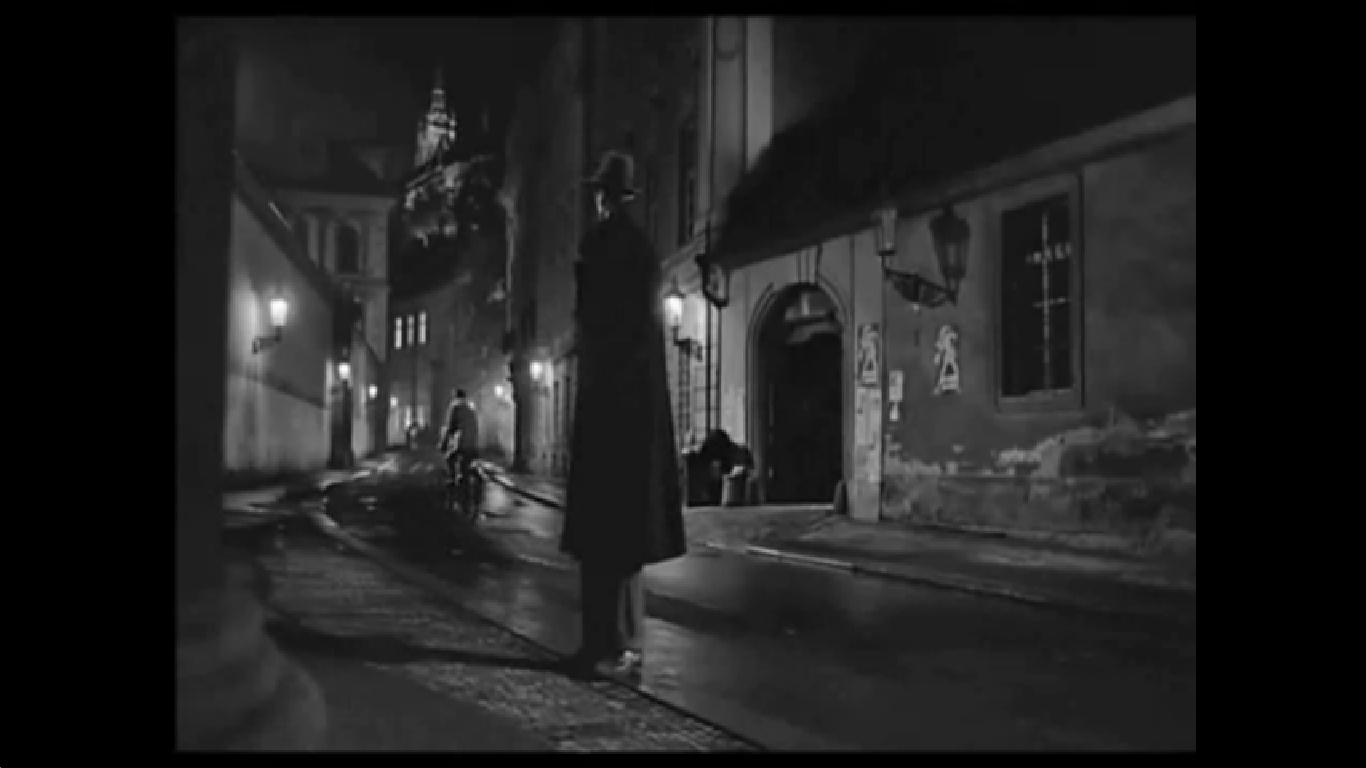
The showdown takes up the final half hour of the film. Clarke keeps things interesting by having Daniels and Armstrong performing their own shots so he can keep the actors in the frame and use sweeping camera angles. There is an expressionist feel to the sets. Everything takes place at night and we never see daylight. Though it seems Randall is just playing at being a vampire there are a couple of moments that suggest he may very well be a creature of the night.
Billy the Kid and the Green Baize Vampire sits uneasily alongside Clarke’s social realist work and is often avoided when critics discuss his work, but there is still a political element with Maxwell representing the establishment and Billy the underclass. Daniels is perfectly cast as the cocky youngster, while Armstrong is an amusing mixture of Northerner and the supernatural. Composer George Fenton ( The Company of Wolves ) acted as the musical arranger for the film. Bruce Payne has a terrific singing voice and gets the best number, ‘I’m The One.’
Billy the Kid and the Green Baize Vampire is unique. It is fair to say there will probably never be another film combining Westerns, vampires, and snooker. Sadly it came out shortly after another British musical, the ruinous Absolute Beginners (Julien Temple 1986) and despite the popularity of snooker Billy the Kid and the Green Baize Vampire never found the audience it deserved.
Author: kevinsturton

Colin Clark seems to be the only person who benefited from the awful movie The Prince and the Showgirl (1957, Laurence Olivier) getting two factually dubious memoirs ‘The Prince, the Showgirl, and Me’ and ‘My Week with Marilyn’ out of the whole farrago. There might well be an interesting story behind this culture clash between two American icons and the British theatrical establishment but Colin Clark has bugger all to do with it. Norman Mailer thought it was comic, the British fancy folk with their curious rituals against two Americans who were self-made and despite their success both painfully shy and out of place.
For the Millers are tied in class knots. English accents, Olivier’s in particular, have to certainly remind them that she is a girl from a semi-slum street and he is a boy from Brooklyn.
Norman Mailer, Marilyn
Franz Kafka on Film
They Drive

Ryan O’Neal as ‘The Driver’ in Walter Hill’s movie The Driver (1978)

Clive Owen as ‘The Driver’ in The Hire: Follow (2001, Wong Kar-Wai)

Dwayne Johnson as ‘Driver’ in the underrated Faster (2010 George Tillman Jr)

Ryan Gosling as ‘Driver’ in Nicolas Winding Refn’s Drive (2011).

Mel Gibson as ‘The Driver’ in the forthcoming Get the Gringo (2012, Adrian Grunberg).
Midnight in Paris (2011, Woody Allen) – Programme Notes
‘Dellamorte Dellamore’ – DVD Review
‘Sleeping Beauty’ – DVD Review
Cast & Crew Interviews are fairly short but in Leigh’s case revealing as she discusses her approach to the film and how she wants the audience to be a “tender witness.” Apart from that there are only trailers; one for Sleeping Beauty, the disturbing serial killer movie Snowtown (2011, Justin Kurzel), and a TV mini-series called The Slap starring Melissa George and Alex Dimitriades.
The Black Pirate (1926, Albert Parker) – Screening Programme Notes
Jane Gardner – Pianist
Jane has accompanied screenings of silent movies in London at the Barbican Centre and the National Film Theatre. This is her second appearance at The Station after accompanying a screening of The General (1926, Buster Keaton) in January.
Douglas Fairbanks (1883-1939)
There’s a great story about Douglas Fairbanks which emphasises the playfulness and remarkable agility of this legendary Hollywood star. While filming Robin Hood (1922, Allan Dwan) the producers forbade Fairbanks from performing an elaborate stunt. The sequence involved Robin riding towards a castle, then holding on to the drawbridge as it is raised, jumping on to a chain and climbing 50 feet up the front of the set. A stuntman was hired and seemingly performed the stunt with aplomb. Until it dawned on the production crew the stunt man was standing next to them watching the show. The figure waving to them from above was the real Doug Fairbanks.
Physically graceful with a gift for comedy Fairbanks quickly became a popular star in Hollywood. An early highlight is the short comedy The Mystery of the Leaping Fish (1916, Christy Cabanne, John Emerson) a Sherlock Holmes spoof with Fairbanks as a detective who uses cocaine for inspiration and solves a crime involving an inflatable beach toy.
In 1919 Fairbanks, his lover Mary Pickford, D.W. Griffiths, and Charlie Chaplin formed the studio United Artists to give themselves more artistic independence. Fairbanks took a huge risk by producing the swashbuckler The Mark of Zorro (1921, Fred Niblo). Nobody had tried anything like this before. In case it failed Fairbanks made a backup film, an ingenious slapstick comedy called The Nut (Theodore Reed 21) about an eccentric inventor.
Zorro was a huge success and turned Fairbanks into the most bankable star around. Fairbanks continued in this vein playing D’Artagnan in The Three Musketeers (21) with Niblo again directing. There quickly followed Robin Hood (22, Dwan), The Thief of Baghdad (24, Raoul Walsh), Don Q: Son of Zorro (25, Donald Crisp), The Black Pirate, and D’Artagnan again in The Iron Mask (29, Dwan).
Aware of cinema’s growing cultural importance. Fairbanks helped create the USCLA’S film programme. An innovator onscreen and off he was one of the first to experiment with sound though the technology wasn’t quite ready for The Iron Mask. Fairbanks first Talkie saw him delivering iambic pentameter in Shakespeare’s The Taming of the Shrew (30, Sam Taylor). His career eventually tailed off and after his marriage to Pickford broke up Fairbanks moved to England. There was one last hurrah in The Private Life of Don Juan (34, Alexander Korda) with Fairbanks as the great lover realising his swashbuckling days are coming to an end.
“Some people can’t tell where it hurts. They can’t calm down. They can’t ever stop howling."
Margaret Atwood, The Blind Assassin
Chungking Express (1994, Wong Kar-Wai) – Classic
“At our closest point, we were just .01cm apart. 55 hours later I was in love with this woman.”
Wong-Kar Wai’s Chungking Express proved to be his breakthrough movie internationally. Kar-Wai’s previous film, the elliptical Days of Being Wild (1991) won him acclaim, but was a box-office failure. Chungking Express contains certain genre elements; a femme fatale, a cop, a drug dealer, but Kar-Wai is more concerned with romantic longing.
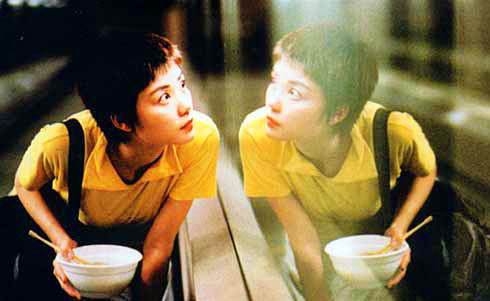
Filmed in and around the Chungking Mansions, a huge residential building in Hong Kong that also contains bars and fast food joints and serves as a meeting point for the city’s ethnic minorities, Chungking Express tells two stories, both about cops and their love lives. Cop No 223 (Takeshi Kaneshiro) becomes infatuated with a mysterious blonde haired woman (Brigitte Lin) he nearly bumps into when chasing a criminal. Cop No 663 (Tony Leung Chiu-Wai) begins a flirtation with an eccentric fast food worker (Faye Wong).
Wong Kar-Wai made Chungking Express while taking time out from his martial arts epic Ashes of Time (1994), a troubled production which went over budget. Chungking Express is the antithesis of the expensive and elaborate Ashes of Time. Together with his cinematographer Christopher Doyle Kar-Wai shot Chungking Express fast and on location. This seemingly improvised style of filmmaking recalls the French New Wave. Doyle makes extraordinary use of artificial lighting in the cramped interiors of the Chungking Mansions.
Wong Kar-Wai gives a sense of time moving on, with shots of clocks changing throughout the film, and occasionally speeding up the film so passers by move rapidly past his protagonists suggesting they are out of step with everybody else. The first segment sees Cop No 223 ruminating in voiceover about the break-up of his relationship, loneliness, and the possibility of finding love while he is still young. The first story is noticeably shorter than the second, which makes sense given Kar-Wai intended Chungking Express to be a three part movie.Kar-Wai would eventually film this final storyline as the full-length feature Fallen Angels the following year.
As entertaining as the first story is it pales in comparison to the second as Faye (Wong) falls for Cop No 663. Bizarrely, her attraction leads her to break into his flat at every opportunity and to become increasingly hard to get. The boyish figured, wide-eyed Wong is astonishing. It may be that Kar-Wai felt he might as well shelve the third part and concentrate on Wong and her will they/won’t they/what is she doing? jousting with Tony Leung’s bewildered beat cop.
Funny, affecting, and rapturous, Chungking Express is the perfect starting point for those unfamiliar with Wong Kar-Wai’s work. Despite being about urban loneliness and heartbreak the film is directed with a lightness of touch that offsets the melancholy. It aches with the possibility that something magical might just be waiting around the corner.