Leaving Your Other Self Behind – ‘The Double Life of Veronique’ (1991, Krystof Kieslowski)

“I have a strange feeling….”

 The Double Life of Veronique saw Krysztof Kieslowski (1941-1996) moving away from the social concerns of films like A Short Film about Killing (1988), and focusing on the supernatural elements that often touched his work. There was always an otherness to Kieslowski’s films; the suggestion of something beyond our understanding. No End (1984) is the most obvious example, with a ghost watching over his ex-wife during a period of political unrest. Tellingly the living and the dead both seem as sad and lost as each other. The Double Life of Veronique is an enigmatic tale of two identical women, Weronika and Veronique, living uncannily similar lives.

Kieslowski claimed not to be interested in politics, but making films under an authoritarian and censorious regime meant there were always restrictions placed upon him. The Double Life of Veronique is Kieslowski’s first film made without fear of outside interference. At one point Weronika walks in a different direction from a political march in Krakow, oblivious to the protesters. Kieslowski seemed to be taking a similar journey, towards something broader and more universal.

Two physically identical women in two different cities; both are singers, both have weak hearts. There is a moment when they almost meet. Weronika (Irene Jacob) is astonished to see a woman who looks exactly like her amongst a group of French tourists. As her doppelganger boards a bus Weronika runs after her and Veronique (Jacob) inadvertently takes her photograph. Kieslowski and cinematographer Slawomir Idziak make the world seem far more beautiful than it normally is bathing it in a permanent golden haze. Photographs, reflections, twin dolls; doubles haunt the film. Often images are distorted by glass, to add to the feeling of otherness.
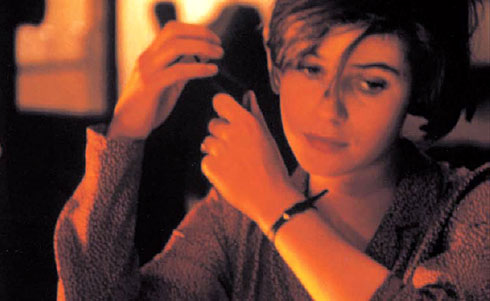


Weronika is full of life. First seen singing in a choir, she keeps singing long after her colleagues have stopped and sought shelter from the rain. She experiences a rapture bordering on the religious. Music also links the two women. Weronika dies during a concert when her heart gives out. Veronique is immediately struck by a feeling of grief. The next day she visits her singing teacher and tells him she is giving up. Veronique seems more tentative than Weronika, more hesitant and troubled, yet we only get to know her after she is affected by this inexplicable feeling of suddenly being alone.

Veronique is drawn towards Alexandre (Philippe Volter), a puppeteer who visits the school she teaches at to perform a marionette show. Alexandre begins to reappear in Veronique’s life as if by coincidence. Veronique retreats from Alexandre when he claims he wants to use her as inspiration for a novel, but they spend a night together in a hotel. Though The Double Life of Veronique presents the doppelganger as being like a lost sibling, there is a brief reminder that the idea of an exact double is often used as a source of terror. Alexandre looks through the photo-reels from Krakow and shows Veronique the picture of a woman he assumes to be her. Yet Veronique knows she took the photo, and she never owned clothes like the one the girl (Weronika) is wearing.
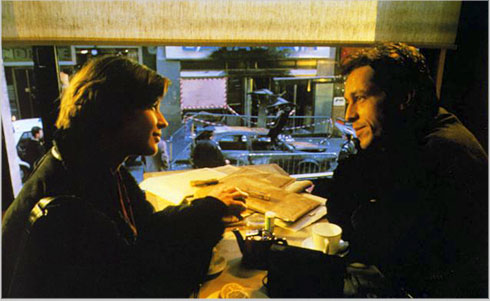


Alexandre creates a story for his marionette show about identical girls; one of whom burns her hand badly by touching a stove, but the other pulls away at the last moment as if influenced by the pain visited upon her double. Veronique backs away from Alexandre and leaves him to his puppets. Kieslowski too shies away from revealing any more as if like Veronique he feels the implications are too much to bear. Kieslowski announced his retirement shortly after the release of Three Colours: Red (1994), despite the film’s commercial and critical success. Like Veronique he returned home. Like Weronika his heart failed him.

Kieslowski commented on the difficulties of conveying “the realm of superstitions, fortune-telling, presentiments, intuition, dreams.” (1) For Kieslowski these make up the inner-life of a human being and no filmmaker since his death has been able to deal with these themes as effectively. German director Tom Twyker tried with the stylish but empty Blind Chance (1981) knock-off Lola Rennt (1998), and the ghastly euro-pudding Heaven (2002), based on an unfinished screenplay by Kieslowski and his regular collaborator Krysztof Piesiewicz. There is no other self out there, another Kieslowski, a doppelganger blessed with the same ability to ask metaphysical questions with a sublime grace.

1.       p 194 Kieslowski on Kieslowski. Faber & Faber 1995


American Reunion

It’s been thirteen years since they graduated from high school and nine since erstwhile pie fucker Jim (Jason Biggs) married expert flautist Michelle (Alyson Hannigan). Now they have a young son whose uncanny ability to appear unannounced in their bedroom has put a dampener on their sex lives. They’re happy enough though and about to head back to their hometown for their school reunion. The rest of the gang have gone their separate ways. Oz (Chris Klein) is now a TV sports anchor famous for a stint on a reality dance show. Finch (Eddie Kaye Thomas) apparently leads a mysterious life moving from country to country. Kevin (Thomas Ian Nicholas) is still fucking boring. Stifler (Seann William Scott) has avoided growing up completely and still lives at home with his hot mom (Jennifer Coolidge). In fact nobody has told Stifler about the reunion figuring he’ll find a way to fuck everything up.

Writer-directors Jon Horowitz and Hayden Schlossberg dealt with the themes of old friends getting back together much better in their last movie A Very Harold and Kumar Christmas (2011). The most entertaining aspect of American Reunion is seeing these former bright young things back together. Especially the ones whose careers crashed and burned like the hapless Chris Klein who has been in the Hollywood wilderness since John McTiernan’s half-assed remake of Rollerball (2002). Klein remains beguilingly sweet as the dumb jock with a good heart despite his woodenness. Even more welcome is the talented Natasha Lyonne who makes a brief appearance here after spending the latter half of the Noughties battling drug addiction. It adds an element of pathos to the proceedings which is handy because the film isn’t particularly funny. 

Been going through Michael Caine’s filmography and watching some of the lesser known films on his CV. Like The Magus, an odd reworking of the Orpheus myth based on a novel by John Fowles; a sort of what’s it all about Orphee? James Clavell’s The Last Valley (1971) which puts the differing factions in the 30 Years War in one small town and works as an allegory for all the other periods of religious based conflict. Peeper (1976, Peter Hyams), with Caine as a 40’s private eye in Los Angeles, Harry and Walter Go to New York (76, Mark Rydell) which wastes not only Caine but the talents of Elliot Gould and James Caan. The two Harry Palmer movies Caine made in the 90’s which I’ve always pretended don’t exist. What struck me most was not just the varied career Caine has had but the number of interesting film directors Caine has worked with. People give him stick for some lazy work in the 80’s and 90’s, usually Jaws: The Revenge (Joseph Sargent) but Caine has worked with some of the best around. Just look at the list below.

Cy Endfield, the American émigré who settled in Britain after fleeing the McCarthy witch hunts and directed one of the great British cult movies Hell Drivers (1957) gave Caine his first major role cast against type as a posh army major. Caine then worked with Otto Preminger in Hurry Sundown (1967), made a wordless appearance in Vittorio De Sica’s portmanteau film Woman Times Seven (67), and persuaded the producers of the third Harry Palmer movie Billion Dollar Brain (67) to hire Ken Russell as director. Too Late the Hero (70) for Robert Aldrich. At his best for Mike Hodges in the classic Get Carter (71), and in the underrated Pulp (73). Squaring off against Laurence Olivier in Sleuth (1972) for Joseph L. Mankiewicz.

 Don Siegel, that most American of directors out of place in a British milieu for the odd thriller The Black Windmill (1974). For another émigré Joseph Losey in The Romantic Englishwoman (1975). Teaming up with Sean Connery in John Huston’s The Man Who Would Be King (75). In John Sturges guilty pleasure The Eagle Has Landed (76). As a castaway captured by buccaneers in the Michael Ritchie oddity The Island (1980), surely an influence on the TV series Lost (2004-10). Brian De Palma (Dressed to Kill)I can take or leave but he has his admirers. Oliver Stone nabbed Caine for his first proper feature The Hand (1980). Sidney Lumet, Death Trap (1982). John Mackenzie made a decent fist of Graham Greene’s The Honorary Consul (1983). Stanley Donen and John Frankenheimer for Blame it on Rio (1984) and The Holcroft Covenant (85) respectively and both past their best.

 Winning an Oscar for Woody Allen’s Hannah and her Sisters (1986). Splendidly nasty as a sleazy gangster in Neil Jordan’s Mona Lisa (1986). Peter Bogdanovich, Noises Off. Russell Mulcahy is admittedly an acquired taste and he has made better films than Blue Ice (1991). After a lean period Caine found himself back in fashion during the ‘Cool’ Brittaina era. Matching Jack Nicholson in Bob Rafelson’s Blood and Wine (1997). A menacing villain in Philip Kaufman’s Marquis de Sade movie Quills (2000). Another Grahame Greene adaptation The Quiet American this timefor the gifted but erratic Philip Noyce. A dignified presence in several Christopher Nolan movies. Truly great in Alfonso Cuarón’s Children of Men.

 Not a bad career for a guy who’s often accused of doing any old crap provided the money is right. 

Harakiri (1962, Masaki Koboyashi)

“Motome Chijiwa was a man of some acquaintance to me.”

Set in 1630 during the uneasy peacetime after a civil war rendered many samurai destitute and masterless, Masaki Koboyashi’s haunting drama functions as an allegory condemning militaristic notions of honour. A bedraggled Ronin Hanshiro (Tatsuya Nakadai) appears at the gates of a noted samurai house and asks for the right to commit hara-kiri in their courtyard. The clan chief tries to warn him off by recounting the tale of a young man named Motome Chijiwa (Akira Ishihama) who arrived at their house and attempted what had become a common practice. Ronin had taken to appearing at the gates of house of repute and asking to commit suicide. Instead they would be given money and food and sent on their way. Motome is made an example of and forced into carrying out hara-kiri with the bamboo blade he carries instead of a real weapon. This sorry tale does not dissuade Hanshiro who seems resolute and determined to die. Yet he has his own story to tell and a very good reason for visiting this particular house. Koboyashi is best known for the ghostly portmanteau film Kwaidan (1964) and he brings a similar eeriness to HaraKiri. Characters are framed against the background in such a way that they seem impermanent, fragile, just passing through. Miike Takashi’s faithful remake HaraKiri: Death of a Samurai (2011) is out next Friday and though it is almost redundant if you have seen the Koboyashi film it does have a remarkably choreographed final confrontation and is well worth a look. 

I borrowed an old pictorial book on Silent movies and found this gem of a poster from 1910. It’s the back in the day equivalent of those adverts warning people to switch off their mobile phones. Ladies in outlandish hats were apparently the biggest menace facing audiences in the early days of cinema.

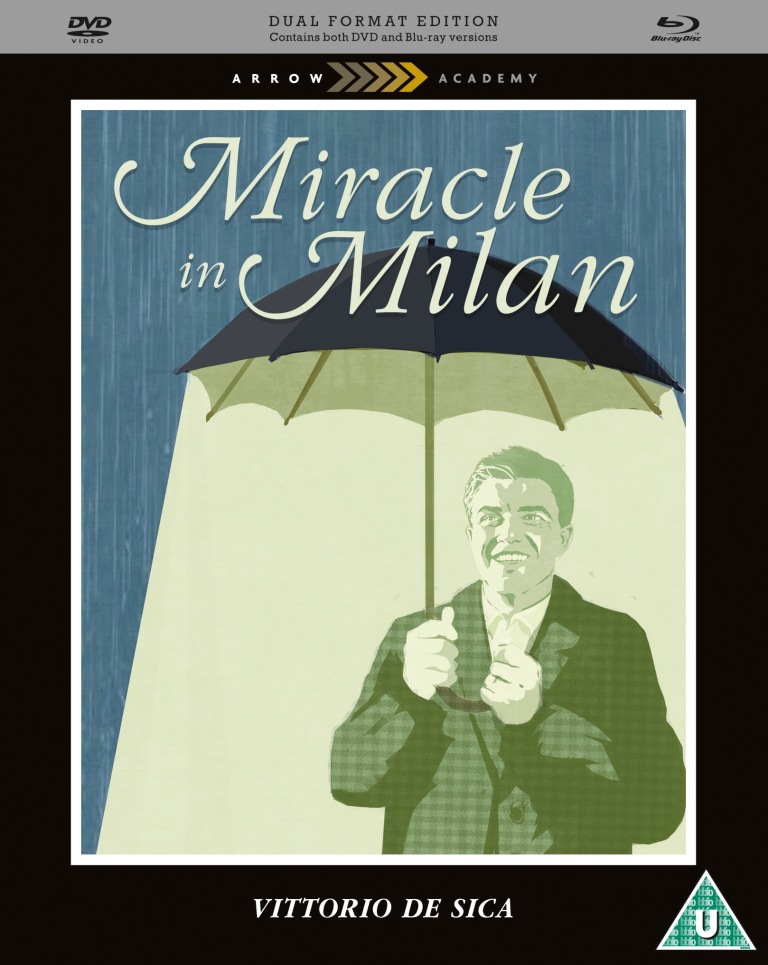
Vittorio De Sica’s Miracle in Milan (1951) has a great DVD release on the Arrow Academy label. Not a big fan of De Sica but this beguiling slice of Magic Realism is much more fun than his best known film Bicycle Thieves (1947).  Bleakest happy ending ever. 

‘Miracle in Milan’ (1951, Vittorio De Sica) – Arrow Academy Bluray

Vittorio De Sica is best remembered for his 1947 movie Bicycle Thieves, an overly manipulative and simplistic piece which is one of those films people pretend to like to impress other folk. Screenwriter Cesare Zavattini and De Sica collaborated on a number of films all dealing with similar themes of social injustice. Miracle in Milan is lighter in tone than their usual fare but just as serious.  By adding comedy and Magic Realist elements to the film they create a sly subversive fairytale which is just as resonant now in this era of recession as it was in 1951. 
Toto (Francesco Golisano) is raised in the country firstly by an elderly lady who takes him in as a baby, then after she passes away he spends the rest of his childhood in an orphanage. Arriving in the city for the first time he is struck by the isolationist nature of the people there and becomes drawn towards the downtrodden finding them to be better company. Moving into a shanty town he inspires the residents to better themselves but when this eccentric self-reliant community proves too successful the authorities move in and try to claim the land. While the first part of Miracle in Milan belongs to the neorealist tradition the latter part of the film moves into the realm of the fantastical as statues come to life, policemen start singing opera, and heavenly messengers appear.
While De Sica and Zavattini make fun of the rich the poor are also targets for satire. They willingly embrace consumerism when Toto gains the ability to make wishes come true and ask for all kinds of luxuries they don’t really need. They and Toto also delight in taking revenge against the man who refuses to conform with the group and eventually betrays them by selling them out to the rich. Toto is a cheerful idiot savant, an unwitting revolutionary who breaks societies rules because he sees no sense in them. The upbeat approach taken by De Sica and Zavattini mirror’s Toto’s optimism and is embodied in the jaunty score provided by Alessandro Cicognini which provides a carnival atmosphere. Yet Miracle in Milan is one of the bleakest films ever made, its magical finale suggesting there is only one way out of the poverty trap. 
Special Features
The latest entry in the Arrow Academyrange Miracle in Milan gets the full Arrow treatment. Bluray and Standard Definition DVD’s accompanying booklet featuring writing on the film as well as John Maddison’s 1951 article ‘The Case for De Sica.’ There are short but enlightening interviews with De Sica’s son, and with actress Brunella Bovo. Newsreel footage of the film’s premiere gives you an idea of just how famous De Sica was in his native Italy and contains a brief interview with the dapper director and Zavattini.
The film’s original trailer for Miracle in Milan is essentially a short film presented by lead actor Golisano outlining De Sica’s career up to that moment and then showcasing the film. There is also a whole other film, Il Tetto (1956), previously unavailable on DVD. Again written by Zavattini it focuses on an impoverished newly married couple trying to find a place of their own during the redevelopment of Romeand is well worth a look.